
 |
 |
 |
 |
 |
 |
 |
“Into the jaws of Death, Into the mouth of Hell, Rode the six hundred” – By Mistake
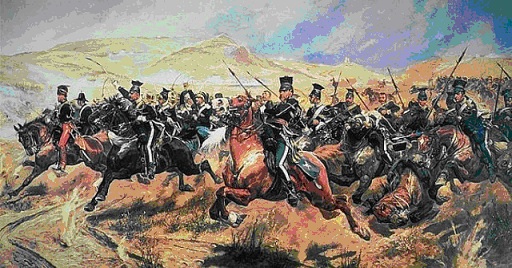
The Charge of the Light Brigade was a relatively minor engagement, in a single battle of a rather pointless war, that was put under a microscope from almost the very moment the survivors returned from their charge.
The overall conflict and the charge gave rise to two distinct varieties of clothing as well as a resoundingly famous poem, noted for being one of few great works of literature that became immediately famous after it was written, and continued its fame even though to modern times.
The Background
The charge was an attack during the Battle of Balaclava during the Crimean War of 1853-56. The war pitted the Russians against the allies of France, the Ottoman and British Empires. The allies quickly invaded the Crimean Peninsula and laid siege to the main port city of Sevastopol.
The allies set up fortified redoubts heights among the rolling hills and valleys around Sevastopol.
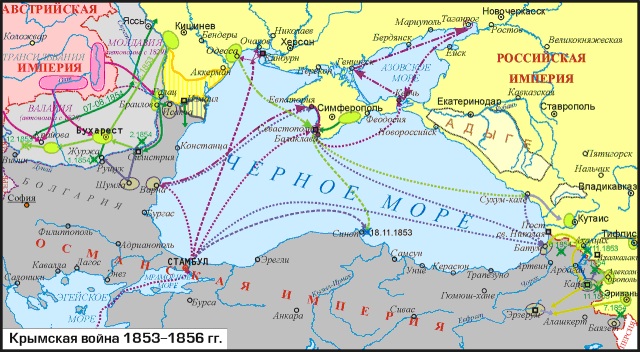
Larger Strategic troop movements of the Crimean War
On October 25th, the Russians attacked from the north against the unprepared British position on the long stretch known as Causeway Heights that ran between the North and South Valleys, close to the British claimed town of Balaclava. The Russian forces quickly set up cannons along the north ridge and eastern edge of the North Valley and captured most of the British cannon redoubts along the southern Causeway Heights.
The British Light and Heavy Brigades were both on the western edge of the North Valley. Overall command fell to Lord Raglan who was positioned on a very high point to the west and able to see the entire sequence of events including the capture of Causeway Heights. Command of the Cavalry fell to the Earl of Lucan while command of the Light Brigade fell to the Lord Cardigan.
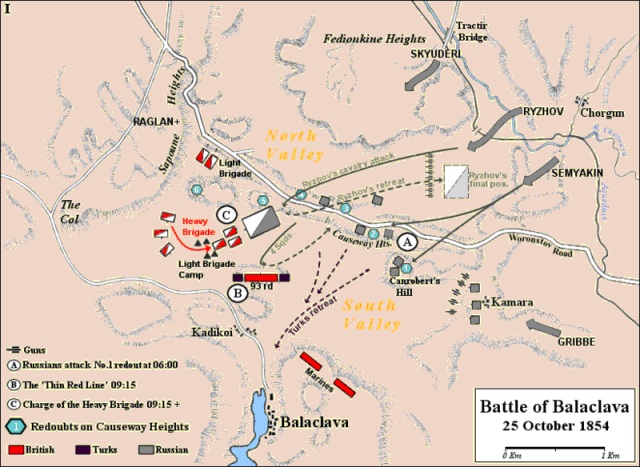
Initial attack by the Russians at the Battle of Balaclava
Before the famous charge, the Russian attack had been halted in large part to a famous stand by a British infantry detachment that stood up to and halted a Russian charge. These men would be famously known as the Thin Red Line and applauded for their bravery. With the lines more or less stable the Russians began seizing the British cannons along the Causeway Heights, infuriating Lord Raglan.
The Order
The cavalry had been holding their position, aware of some attack but occupying a lower position in the valley. Lucan was given an order by a messenger from Raglan that ordered a cavalry attack on the causeway that “will be” supported by infantry. Raglan had intended that the cavalry attack immediately with later support by the infantry as the Russians were still disorganized and laden with the captured cannons.
Lucan, knowing that cavalry traditionally was supported by infantry, interpreted the “will be” part of the order as meaning that infantry will be there for support soon, and once that occurs, launch an attack, so Lucan and the cavalry remained idle.
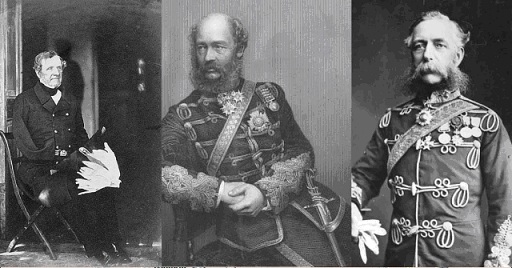
From left to right, Lords Raglan, Lucan and Cardigan. the fault for the failed assault falls to some degree to each of these men, though only one, Cardigan, actually had to brave the terrible conditions of the charge.
Lord Raglan saw that his order for immediate attack was simply not being followed drafted another message with specifications saying he wishes the cavalry to advance rapidly to the front and prevent the enemy from withdrawing with the guns. Raglan intended this to be a follow-up to the last order that mentioned the target of Causeway Heights though it was not reiterated in the second written order.
Rather than sending the typical messenger, Raglan sent a nearby captain Nolan, known for his speed on a horse. Nolan may or may not have gotten verbal confirmation of the target being the Causeway before setting off to Lucan. Nolan was known as a hot-headed and aggressive officer who was especially critical of Lucan’s past cavalry tactics, which he thought were overly cautious. When he reached Lucan he seems to have been enraged by Lucan’s inactivity and gave the order.
Though Lucan should have realized that the order intended the target to be the Causeway Heights, he was confused as from his position he could not see any guns on the causeway as they were just on the other side of the causeway’s ridge. Asking Nolan for clarification he said “what Guns, sir.” Nolan angrily replied “There my Lord is your enemy” and vaguely waved his arm eastward towards that valley saying “there are your guns”
Lucan and his officers could only see the guns at the far eastern end of the valley over a mile away and could only assume that those were the target. Though knowing that the attack was illogical and almost suicidal, the order was given. Cardigan was said to have mentioned that the Russians had cannons on either ridge and their target, more cannons, was over a mile away with Russian riflemen scattered throughout the valley. Lucan replied to him that “But Lord Raglan will have it. We have no choice but to obey”.
|
|
 |
 |
 |
 |
 |
 |
 |
 |
 |
 |
 |
 |
 |
 |
 |
 |
 |
 |
 |
 |
 |
 |
 |
 |
 |
 |
 |
 |
 |
 |
 |
 |
 |
 |
 |
 |
 |
 |
 |
 |
 |
 |
 |
 |
 |
 |
 |
 |
 |
 |
 |
 |
 |
 |
 |
